

The 60/40 portfolio calls for a new approach

20 May 2026 by National Bank Investments
A person balancing small stones on top of each other

Markets feel different than they used to and investors currently looking at their portfolio have likely noticed this. Higher interest rates, lingering inflation, and sharp swings in both stocks and bonds have made investing more challenging. The old idea that bonds always offset stock risk hasn’t held up as consistently.
The traditional 60/40 portfolio doesn’t necessarily hold up anymore. Which is why more investors have started exploring liquid alternatives as a way to strengthen their portfolios.

Why traditional portfolios are being tested

For a long time, building a portfolio was relatively straightforward: stocks for growth, bonds for stability. But recent years have shown that stocks and bonds can decline at the same time, market volatility can show up suddenly and last longer and economic outcomes are harder to predict.

Traditional portfolios are not broken, but diversification beyond stocks and bonds matters more than ever, leading many investors to liquid alternatives.
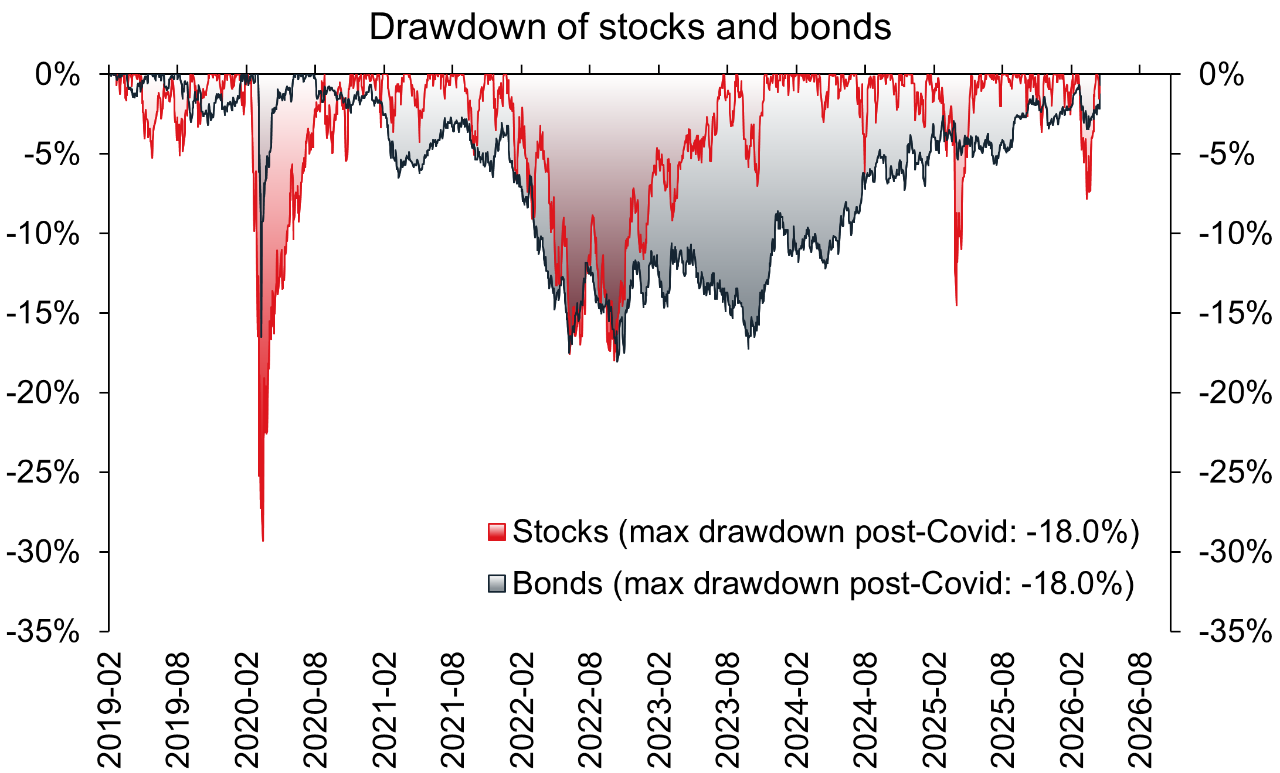
Chart that shows declines in stocks and bonds since 2019

Source: NBI and Refinitiv.  For Illustrative purposes only.

What are liquid alternatives?

Liquid alternatives are investment strategies designed to behave differently from the stock and bond markets, while still being easy to buy and sell.

Many liquid alternatives are offered as an ETF or mutual fund and offer key features such as daily liquidity, transparency and are designed to manage risk. They don’t rely solely on markets going up to make money and that can be valuable when markets are choppy.

Why liquid alternatives make sense now

Liquid alternatives make sense in today’s markets because conditions are more uncertain and less forgiving than they were for much of the past decade. Interest rates have moved higher and stayed there longer as central banks continue to manage inflation, increasing bond volatility and reducing their ability to consistently offset equity losses. 

Markets have also become more reactive, with economic data, policy signals, and geopolitical events triggering frequent and sudden price swings. Instead of steady trends, investors now face sharper drawdowns and less predictable recoveries. 

What liquid alternatives can do for a portfolio

1. Reduce portfolio swings

Liquid alternatives aim to smooth out ups and downs. They may not deliver big gains in strong bull markets, but they can help limit drawdowns when markets struggle.

2. Add real diversification

True diversification means owning assets that don’t all move together. Many liquid alternatives follow different return drivers, such as market trends, relative pricing, or defensive positioning.

3. Help you stay invested

Large portfolio losses can lead to emotional decisions. A smoother ride can make it easier for investors to stick with their long term plan.

4. Adapt to changing conditions

Some liquid alternative strategies adjust exposure as markets evolve, rather than staying fully invested regardless of risk.
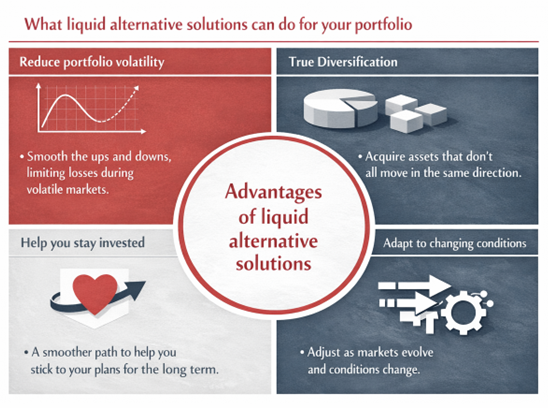
Diagram that shows the benefits of liquid alternatives

The bottom line

For many investors, liquid alternatives can be a practical way to strengthen a portfolio. They add enhanced diversification beyond stocks and bonds, help navigate market volatility more thoughtfully, and support a portfolio that is better prepared for uncertainty. While they do not fully eliminate risk, liquid alternatives are designed to help manage it more effectively, especially in markets like today’s.

The information and the data supplied in the present document, including those supplied by third parties, are considered accurate at the time of their printing and were obtained from sources which we considered reliable. We reserve the right to modify them without advance notice. This information and data are supplied as informative content only. No representation or guarantee, explicit or implicit, is made as for the exactness, the quality and the complete character of this information and these data. The opinions expressed are not to be construed as solicitation or offer to buy or sell shares mentioned herein and should not be considered as recommendations.

NBI exchange-traded funds (the "NBI ETFs") are offered by National Bank Investments Inc., an indirect wholly owned subsidiary of National Bank of Canada, and sold by authorized dealers. Management fees, brokerage fees and expenses all may be associated with investments in NBI ETFs. Please read the prospectus or ETF Facts document(s) before investing. NBI ETFs are not guaranteed, their values change frequently and past performance may not be repeated. NBI ETFs units are bought and sold at market price on a stock exchange and brokerage commissions will reduce returns. NBI ETFs do not seek to return any predetermined amount at maturity. The NBI ETFs’ securities are not insured by the Canada Deposit Insurance Corporation or by any other government deposit insurer. The performance of a NBI ETF does not match the performance of the index. The indicated rates of return are the historical total returns for the periods including changes in unit value and reinvestment of all distributions and do not take into account sales, redemption, commission charges or income taxes payable by any unitholder that would have reduced returns.

® NATIONAL BANK INVESTMENTS is a registered trademark of National Bank of Canada, used under licence by National Bank Investments Inc.

© National Bank Investments Inc., 2026. All rights reserved. Any reproduction, in whole or in part, is strictly prohibited without the prior written consent of National Bank Investments Inc.

National Bank Investments is a signatory of the United Nations-supported Principles for Responsible Investment, a member of Canada’s Responsible Investment Association, and a founding participant in the Climate Engagement Canada initiative.

No Result found